The Handcart Economists: Abidjan's Ice-Chest Vendors and the Cold Route That Runs the City
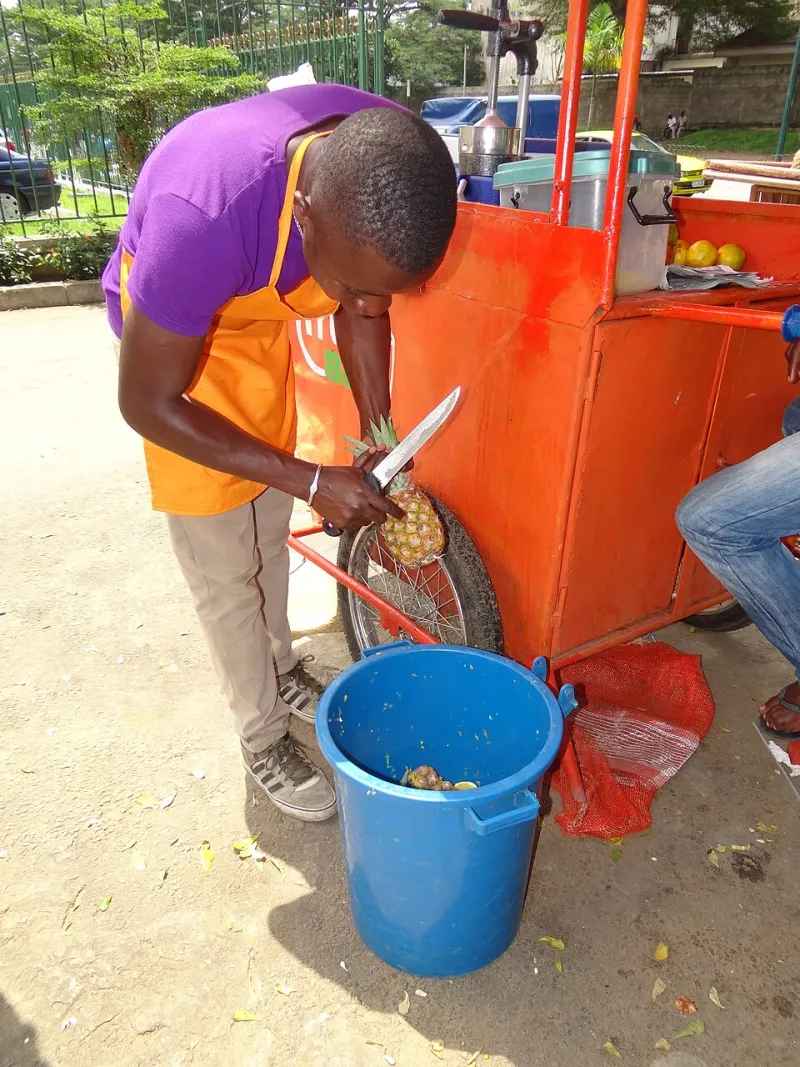
Photo: Hanay, CC BY-SA 4.0, via Wikimedia Commons
At 6:30 on a Tuesday morning in Adjamé, a handcart rolls out of a side street with a blue ice chest strapped to its frame. There is no sign, no awning, no cash register. The cooler is the storefront. By 7, it will be parked near a gbaka stop, lid open, sachet water and chilled bissap catching the first commuters. By noon it will move to a construction site. By 5 it will be back at a carrefour for the ride home. This is the smallest business model in Abidjan, and it runs on ice, timing, and trust.
The Morning Ice Run Is the Business Plan
Every route starts with ice. Vendors buy blocks or crushed ice from a factory outlet, a cold-store, or a larger distributor—sometimes in Adjamé, sometimes closer to their commune. The first transaction of the day is rarely cash-on-the-barrel. A known vendor can take ice on a tab and settle up at dusk. That informal credit is the working capital. Without it, the cooler stays empty and the route never starts.
US side-hustlers talk about lean startups and minimum viable products. Abidjan's ice-chest vendors have been running that playbook for generations. The ice is inventory. The handcart is the delivery van. The route is the business plan. The supplier's trust is the line of credit. And the margin? Thin, but real—if you move fast enough.
The Route Follows Small Crowds
The cooler does not wait for customers. It goes where people already are. In Abidjan, a carrefour is not just an intersection; it is a temporary mall. At 7 a.m., it is gbaka passengers and office workers. At noon, it is laborers and market shoppers. At 3 p.m., it is school kids with a few coins. At 5 p.m., it is the long ride home. The vendor reads the clock and the crowd, then moves.
Construction sites are another reliable stop. A crew working under the sun will buy water and cold soda by the crate if the cooler arrives at the right moment. School gates want chilled yogurt and sweet drinks. Bus stops want sachet water and bissap. The mix changes by location, which means the cooler is never stocked the same way twice. Every item has to earn its place. This is SKU discipline in its purest form: if it does not sell before the ice melts, it does not come back tomorrow.
What's Actually in the Chest
The standard load is sachet water—small sealed bags of drinking water sold by the handful—plus chilled yogurt, bissap, soda, and sometimes dèguè, a millet-and-yogurt drink. In wealthier areas, you might see bottled water and imported juice. Near a market, it is sachet water and homemade bissap. Near a school, it is sweet, cold, and cheap. The cooler is a small store with a very short shelf life, so the vendor's job is not to offer everything. It is to offer exactly what the next crowd will buy.
This is where US side-hustlers can learn something. A food truck with fifty menu items is not lean; it is a restaurant on wheels. An ice-chest vendor with six items is lean. The constraint forces focus. The cooler is small, so the inventory has to be fast-moving, high-margin, and easy to carry. If you are starting a weekend pop-up or a farmers market stall, ask yourself: what is my ice chest? What is the one thing I can sell before it melts?
Credit Is the Second Cooler
The ice tab is only one form of credit. Vendors also rely on relationships with property owners, security guards, and regular customers. A spot near a busy carrefour might come with an informal daily fee or a favor. A security guard might let a cart park in the shade. A regular customer might pay later. None of this is written down. It is reputation accounting, and it is as important as the cash in the pocket.
In the US, we tend to think of credit as a card, a score, a bank. In Abidjan's ice-chest economy, credit is a nod from the ice seller and a habit of paying on time. That is a lesson for anyone building a small business: your supplier relationship is your first line of credit. Treat it like a bank account, because it is one.
The Overhead Is a Handcart and a Reputation
There is no rent, no electricity bill, no point-of-sale system. But overhead is not zero. Ice costs money. The handcart needs repairs. The cooler needs replacing every few years. A phone is needed for orders and for coordinating with suppliers. Some vendors pay a small daily fee to park in a high-traffic spot. The business is low-margin and high-turnover. The goal is not to sell out once; it is to sell out before the ice gives out.
That is a useful distinction for US city planners and side-hustlers alike. Low overhead does not mean no costs. It means costs you can see and control every day. The ice-chest vendor knows exactly what the day costs before the first sale. That clarity is a competitive advantage.
What US Cities Can Steal From a Cooler
American cities often regulate street vending around trucks, stalls, and permits that assume a fixed location. The ice-chest vendor is smaller, nimbler, and harder to fit into those boxes. But the model offers real lessons. If a city wants micro-entrepreneurship, it needs places where people already wait: transit stops, construction sites, school gates, market edges. It needs access to ice and shade. It needs permits that scale down to a handcart. And it needs micro-credit that trusts a route record, not just a credit score.
Think of it as food-cart policy, but lighter. A vending zone near a bus terminal does not need to be a permanent market. It can be a few shaded spots, a water tap, and a clear rule about where a cart can park. That is infrastructure for the smallest businesses. And in a city like Abidjan, those smallest businesses are not a niche. They are the retail layer that fills the gaps between stores.
The Settle-Up
At dusk, the cooler comes back empty. The vendor counts cash, pays the ice tab, and maybe buys tomorrow's ice on the spot. The handcart is parked. The route is done. Tomorrow it starts again. The smallest business model in Abidjan is not small in ambition. It is a daily negotiation between ice, time, trust, and feet—and it is one of the most efficient retail systems in the city.