Clips, Clippers, and Arguments: Inside the Yopougon Barbershop Where the Whole Block Gets a Say
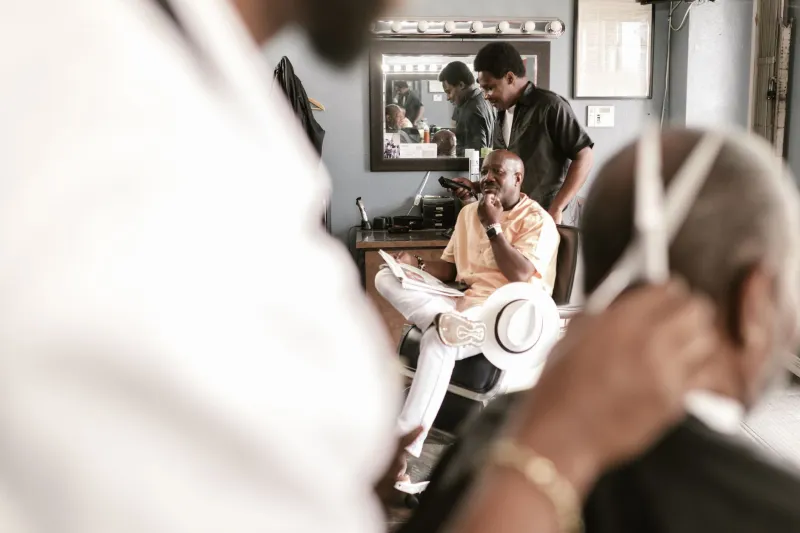
The chair is the podium. Everything else — the mirror, the hand-painted glass panel on the door, the TV bracketed to the wall at an angle that guarantees glare — is just scenery for whoever is talking.
On a side street off Boulevard Principal in Yopougon, a shop the size of a large closet opens at eight and stays busy until the fan gives out. There's a strip of faded team photos wedged into the mirror frame, a poster for a concert that happened a while ago, and a plastic kettle that has never once been off. Two barbers work. On Saturdays there's a third chair pulled in from the back, and a fourth kid sweeping hair into a pile that looks like a small gray animal.
A haircut runs somewhere around 1,000 to 2,000 CFA francs — two, three dollars and change. Which is the point. The price is low enough that the room isn't sorted by income, and the conversation doesn't care who's in the chair.
Two Chairs, One Mirror, Zero Agenda
What's on the menu this afternoon: a taxi driver's take on a road closure, a student's complaint about an exam, a heated review of a match that ended two days ago, and a ten-year-old's very firm opinion about a rapper. Nobody called a meeting. Nobody scheduled it. There is no agenda, which is exactly why it works.
The man in the chair is mid-fade, and he isn't the center of attention. The room is. That's the whole design — the person being served has somewhere to sit and nothing to prove, and everybody else gets the floor for twenty minutes.
The Fade Is a Policy Debate
The dégradé gets argued about the way other cities argue about parking. How high the line goes. Whether the back should be blocked or tapered. Whether a shaved design — a lightning bolt, a jersey number, a name — is a sharp detail or a crime against a good haircut.
A barber named Yannick explains the rule he actually enforces: "You tell me what you want. I tell you what your head will do." Style here is not a catalog choice. It's a negotiation between a customer's idea of himself and a barber who has seen four hundred versions of that idea and knows which ones work on a Tuesday and which ones need a week to settle in.
Watching a teenager leave with a line he asked for and slightly regrets is one of the better free shows in the city. He'll be back in nine days. He always is.
Where the National Team Lives Between Matches
Les Éléphants come up constantly. The 2024 Africa Cup of Nations title — won on home soil in Abidjan — is still ammunition in a way that hasn't cooled down. Old arguments get recycled: the midfield, the coach, the player who should have been called up and wasn't. Someone will say the team has no plan. Someone else will say the plan is fine and the finishing isn't. The kettle gets refilled.
On match days the shop rearranges itself. Chairs turn toward the screen, the haircuts slow down, and a room built for six holds eleven. The barbers keep working through it, because they've learned that a client would rather be half-turned in a chair than miss a goal standing up.
Marcory's Version: Younger, Louder, Faster
Cross into Marcory and the format changes. The shop is bigger, the music is louder, the crowd skews younger, and the arguments run shorter before somebody's phone interrupts. There's a maquis next door, so the conversation splinters and reassembles as people drift in and out between errands.
Yopougon's room is slower and older. Marcory's is faster and noisier. Both do the same job, which is to give people a place to be somewhere without having to purchase a reason.
What Gets Said Here That Never Gets Posted
Here's the thing that stands out to an outsider: the room polices itself, and it does it politely. Elders get the floor. When a sixty-year-old starts talking, the phones go down — not because anyone announces it, but because that's what happens. A nineteen-year-old can absolutely disagree with him, and the disagreement can go on for six minutes, and at the end it's a handshake and someone laughing and the kettle going around again.
That's a low-stakes, high-trust argument — the kind that barely exists online, where disagreements turn into permanent verdicts about a person. In this room, a bad take this afternoon is a joke by Thursday. You get to be wrong in front of people who'll still nod at you on the street.
Why US Blocks Are Missing the Room
American cities aren't short of barbershops. In plenty of them, the shop is already exactly this — an institution, a pulpit, a place where business gets done and kids get watched. That's not a lesson Abidjan needs to teach; it's a thing we should protect.
But elsewhere the pattern is thinning out. The coffee shop is expensive and quiet. The bookstore has a table and a rule about silence. The third-place argument keeps getting made and the rent keeps winning. Where a room does survive, it's often sorted by age or by interest, so the ten-year-old, the taxi driver, and the retired teacher never end up in the same conversation about the same subject.
Abidjan's barbershops do it accident-driven, on a cheap chair, with no programming and no sponsor. The business model is a haircut. Everything else is surplus, and the surplus is the part people actually come back for.
House Rules, If You're New
Bring a topic, not a grudge. Wait your turn and don't talk over your elder. Tip. Laugh at yourself before someone else does it for you. And if you're only there to listen, that's allowed — the room will eventually ask you a question anyway.