Bring a Photo, Leave With a Fit: How Abidjan's Small Tailoring Shops Beat Fast Fashion at Its Own Game
You smell an Abidjan atelier before you see it: hot cotton, machine oil, a faint sweetness of starch. On a side street off Boulevard de Marseille in Treichville, a blue metal door stands propped open with a brick, and inside, a ceiling fan moves the heat around without ever actually beating it. Two machines run. A radio plays coupé-décalé at a volume that suggests nobody is really listening.
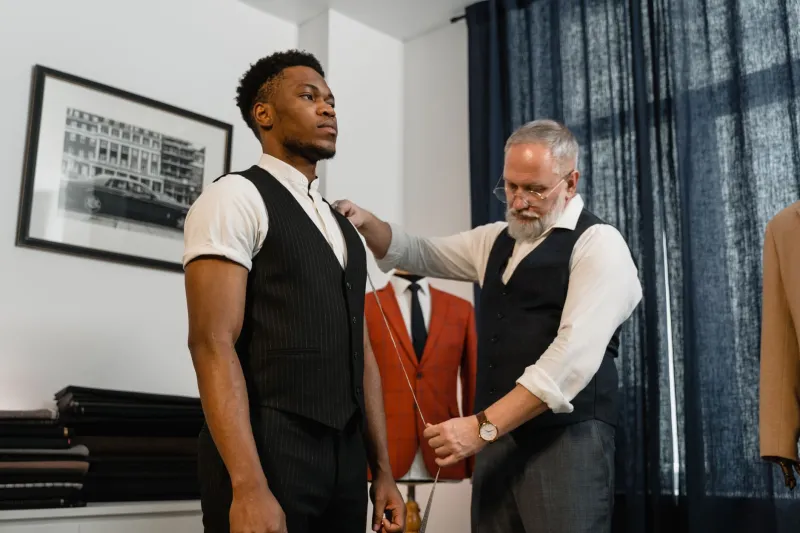
A woman in a navy skirt suit is standing on a low stool while a tailor named Konan runs a tape measure across her shoulders. She has a screenshot on her phone — a blazer she saw online, cropped, sharp shoulder, no visible buttons. She has a bolt of wax print under one arm. She has a wedding in Grand-Bassam in eleven days.
That is the whole ritual in a single frame, and it happens thousands of times a week in this city — in Treichville and Cocody, in the stalls behind Adjamé market, in living rooms in Yopougon where a sewing machine sits where a couch used to be.
Made-to-Measure Isn't a Luxury Here. It's the Default.
In the US, "custom tailoring" usually means a waitlist, a showroom, and a number with four digits before the comma. In Abidjan, the couturier down the street is the practical option. Off-the-rack exists, but the working assumption is different: clothes are supposed to fit the body you actually have, not an averaged-out mannequin built from somebody else's data.
A two-piece outfit in wax print typically lands somewhere between 25,000 and 60,000 CFA francs — roughly $40 to $100 — depending on fabric and how booked the tailor is. A structured blazer runs higher. A school-uniform run for a family of four is a normal Tuesday. Somebody's cousin is always getting married, which means somebody's tailor is always three garments deep in a good week.
What the Tailor Is Actually Reading
Konan doesn't start with the tape. He starts with your posture — how you stand, where your shoulders sit when you're not posing, whether you lean. "I look at how you stand before I look at the number," he says, chalking a line. Repeat clients have cards, or in his case a notebook with names, dates, and small notes that mean nothing to anyone else.
The fitting is where the garment becomes yours. Shoulders get pinned, armholes get corrected, hems get argued over. Nobody is offended by a second visit. In fact, a tailor who hands you a finished piece with no fitting is either very good or in a hurry, and you should find out which.
How to Judge Fabric Before You Spend
Wax print is the workhorse here, and the market is full of imitations. Three checks that cost nothing:
- Turn it over. Real wax print carries its pattern on the reverse side too. A one-sided back means you're looking at a printed imitation, which is cheaper and will fade faster.
- Crush a corner in your fist. Genuine wax relaxes and springs back with a soft crackle. The imitation stays stiff and plasticky and holds the crease.
- Ask the tailor. They will be blunt, because a bad fabric makes their work look bad. If they wince, put it down.
Also ask the price per yard and how many yards a garment needs. Shops sell by the pagne (usually a six-yard cut in two pieces), so knowing the unit changes the math on whether that dramatic pattern is a bargain or a splurge.
Commissioning From the US: A Realistic Playbook
Plenty of people in the States now order from Abidjan tailors, usually after a trip or through family. It works — with a few guardrails.
Find the tailor through a person, not a random DM. A friend, a relative, a colleague's recommendation. Ask for photos of finished work on real clients, not just flat-lay shots.
Get measured properly. Snug tape, feet together, don't suck anything in. A tailor can fix a hem from across an ocean. Shoulders and armholes are where remote orders go to die.
Choose fabric on the ground if you can. A cousin with a phone camera inside a fabric shop will outperform any product page.
Pay the deposit and expect mobile money. Half up front is normal — Wave, Orange Money, MTN. Get the balance terms in writing, even if "in writing" means a text thread.
Treat the deadline as a negotiation. Build in a week of buffer. "Ça arrive" is a polite word that can mean many things, and none of them is "tomorrow at nine."
Have someone do the fitting in person. Then budget shipping and customs on top of the garment price; a $70 piece can pick up another $30 in transit, and overnight it twice and you've erased the savings.
Plan retouches locally. A neighborhood alterations shop can handle a hem or a waist. Nobody in Ohio is resetting an armhole for $15.
The Etiquette Nobody Prints on the Wall
Don't haggle by insulting the work. Ask what's possible before you ask what's cheap. Call ahead instead of showing up at closing. Pay the balance without being chased for it. Understand that your tailor has thirty other clients, a family, and possibly a second machine running in the back room.
A rush job is a favor, and favors in Abidjan are relationships, not transactions. The clients who get their clothes on time are usually the ones who've been coming for years — and who bring the tailor a small something at the holidays.
Why the Logic Travels
You don't need a plane ticket to test the principle. Every US city has alterations shops, dry cleaners with a sewing machine in the back, and small-batch makers working out of storefronts. The Abidjan habit is simply to use them before you buy — to decide the fit first and the garment second.
One piece that actually fits will outlast five impulse buys that don't. Ask anyone standing on that stool in Treichville, eleven days out from a wedding, being told to stop slouching.