A Screwdriver and a Receipt Book: Inside the Adjamé Stalls That Refuse to Call Your Phone Dead
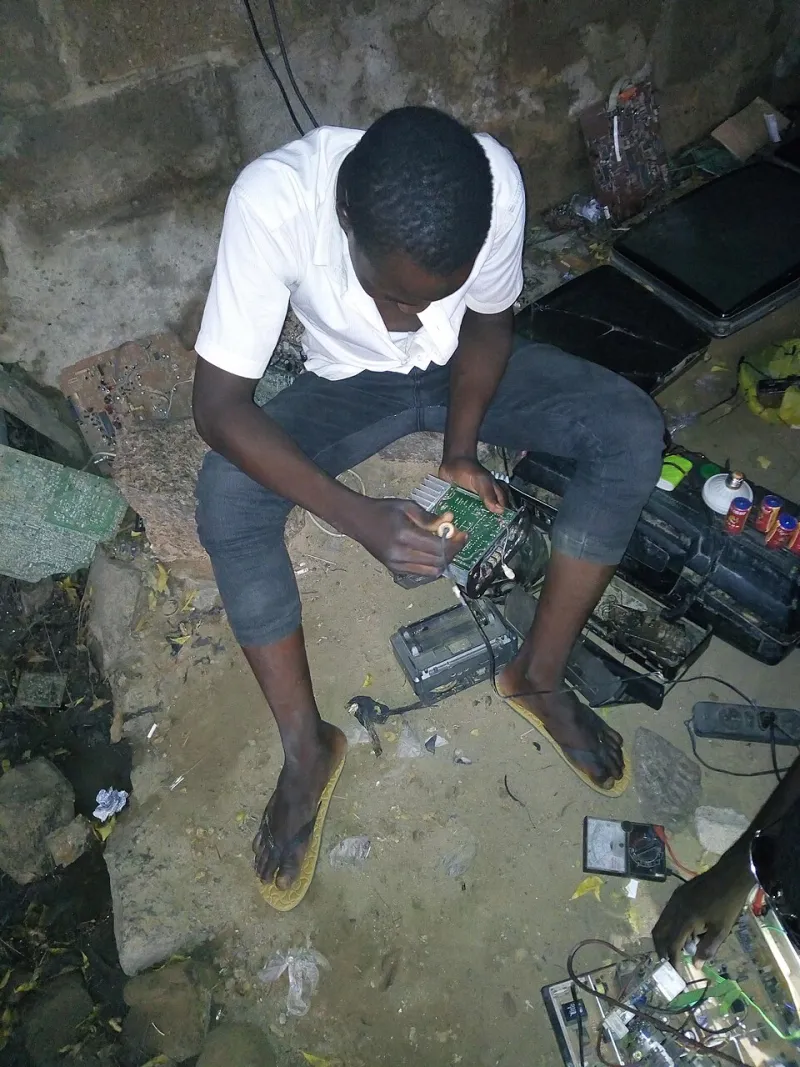
Photo: Tokarawa, CC BY-SA 4.0, via Wikimedia Commons
In Adjamé, the first thing a broken phone meets is not a landfill. It is a small table, a plastic stool, and a technician who squints at the screen as if it has personally offended him. The market around him is loud enough to make a conversation feel like a negotiation, which is convenient, because it usually is one. Somewhere between the fabric stalls and the phone-case racks, a dead handset gets a second opinion.
That second opinion is the whole story. In the US, we have gotten very good at the clean binary of replace or repair: the cracked screen, the swollen battery, the laptop that will not charge. We box it up, price a new one, and call the old one garbage. In Adjamé, the binary is messier and more social. A phone is not declared dead. It is investigated, argued over, borrowed from, and sometimes resurrected with a part that came out of another phone that was also not quite dead.
The stall as a front desk for the neighborhood
A repair stall in Adjamé does not look like a service center. There is no queue-management system, no branded polo shirt, no laminated sign promising a ninety-day warranty. There is a guy with a set of tiny screwdrivers, a magnifying lamp, a bowl of buttons, and a receipt book that looks older than some of the phones he fixes.
But watch the stall for an hour and it starts to resemble a front desk. A woman drops off a phone and asks the technician to keep it until payday. A teenager arrives with a cracked screen and a story about a football match. Someone else is not there for a phone at all—he needs a fan repaired, or a kettle, or a radio that has been sitting in a cupboard since the rainy season. The technician listens, quotes a price, argues about the price, and then quotes another price. The argument is not a breakdown in service. It is the service.
This is the part that gets lost when repair culture is described as nostalgia. The Adjamé stall is not a cute throwback to a time before disposable electronics. It is a working social infrastructure. It runs on repeat customers, neighborhood reputation, and the kind of trust that does not come from a corporate guarantee. It comes from the fact that everyone knows where you sit.
Why “dead” is a negotiation, not a diagnosis
In a US mall, a technician following a script might tell you a repair costs more than a new device. That can be true. But it is also a decision shaped by parts pricing, labor time, and the economics of upgrades. In Adjamé, the calculation is different. Labor is cheaper, spare parts circulate through informal networks, and the technician has a strong incentive to try the weird fix before the expensive one.
That does not mean every repair is a miracle. Some phones are genuinely finished. Some repairs fail a week later. Some technicians are better than others, and the market does not always protect the customer. But the default assumption is different: before you throw it away, you open it. You check the ribbon cable. You swap the battery. You test the charging port. You ask whether the problem is the phone or the charger, the screen or the connector, the device or the person using it.
That default is worth exporting. In the US, right-to-repair laws have been moving through statehouses and boardrooms, and the conversation often centers on access to parts, tools, and manuals. Those are essential. But Adjamé suggests that repair also needs a culture—a habit of asking who can fix it, where they are, and what it will cost in time and trust rather than just dollars.
The receipt is a face
One of the quiet geniuses of the Adjamé repair economy is that the warranty is often a person. You do not get a call center. You get the technician’s number, or you get the knowledge that he sits at the same table every day. If the repair fails, you go back. He looks at it again. There may be another argument. There may be a discount. There may be a shrug and a promise to try something else.
That kind of accountability is hard to scale, and it can be uneven. It depends on memory, proximity, and reputation. But it also creates a form of consumer protection that feels strangely modern: the repair is embedded in a relationship, not buried in a terms-of-service page. For US cities trying to build repair economies, that is a useful reminder. A repair café or a certified technician is not just a vendor. It is a node in a local network. The more visible and repeatable that relationship is, the more likely people are to choose repair over replacement.
What Adjamé teaches US cities about repair
The lesson is not that every American should start haggling over a phone screen in a market. The lesson is that repair survives when it is convenient, social, and trusted. Adjamé has all three, even if it lacks the polished storefront. A US city can have the opposite problem: good repair options exist, but they are scattered, intimidating, or invisible. The result is that people default to the upgrade.
There are signs of change. Repair cafés, library tool-lending programs, and independent phone shops are filling gaps in US cities. Right-to-repair rules are making parts and manuals more available. But policy alone does not create a repair habit. Habits come from seeing a neighbor fix something, from knowing where to go, from believing that the person behind the counter will still be there next week.
The limits of the romance
The Adjamé repair stall should not be romanticized into a perfect alternative economy. It operates in a context of limited formal protections, uneven access to original parts, and real financial pressure. Some repairs are workarounds, not solutions. Some devices are kept alive because a new one is out of reach, not because the owner is making a green lifestyle choice.
Still, the stall offers a corrective to the US assumption that replacement is the natural endpoint. It treats electronics as repairable objects and repair as a public skill. That is not nostalgia. It is a practical argument about waste, cost, and community—one that arrives not from a policy paper but from a table in Adjamé, where a phone that was declared dead is getting one more chance.