The Room Reader: Abidjan's Freelance Party Conductors Are the Secret to a Night That Won't Sit Down
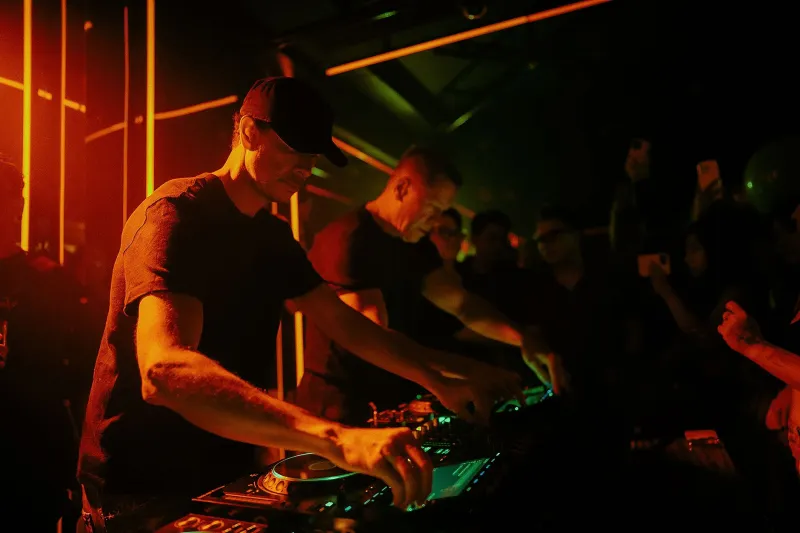
At a wedding in Cocody, the DJ is doing his job. Speakers are stacked, levels are respectable, and the first course has landed. But the dance floor is still a rumor. Then the ambianceur takes the mic—not to shout over the music, but to ask the room a question. The answer comes back from the back tables. Then from the aunties. Then from the kids who have been circling the floor since the appetizers. By the time the second question lands, the party has a pulse.
That moment is the product. In Abidjan, a good ambianceur is hired to keep a night from flatlining. The job title sounds like hype, but the work is closer to hosting, coaching, and live editing. They are freelance MCs, maquis regulars, wedding-committee secret weapons, and baptism-party conductors. They don't replace the DJ. They translate the DJ's set into something a specific room can use.
The gig starts before the first song
A lot of US event planning treats the microphone as a switch: hand it to someone funny, hope for the best. In Abidjan, the preparation is more deliberate. An ambianceur may get briefed by the family, the maquis owner, or the committee running the wedding. Who is shy? Which uncle needs a job so he stops rearranging chairs? Which cousin will start a line dance if someone gives her the first step? Who is likely to leave early, and what would make them stay for one more song?
That information matters because an ambianceur is not performing for the room so much as conducting it. Rates vary by neighborhood, event size, and how late the night runs, but the basic deal is the same: you are paying someone to pay attention. A DJ can watch a crowd. An ambianceur works the crowd—table by table, cluster by cluster—and adjusts the plan in real time.
Call-and-response is not a gimmick. It's infrastructure.
To an outsider, the chants can look like crowd warm-up tricks. They are more useful than that. Call-and-response gives a room a low-pressure way to participate. You don't have to be a great dancer. You don't have to know the song. You just have to answer back. That answer is a small social contract: I am here, I am with you, I am willing to be part of this.
The best ambianceurs use those rituals to build layers. First the kids, because they are easy. Then the table of friends who need a reason to stand up. Then the elders, often with a dedication or a name check that makes the room turn and applaud. By the time the dance floor is full, the crowd is not waiting for permission from the DJ. It has already given itself permission.
Reading a room in three speeds
Ask an experienced ambianceur what they are looking for and you won't get a mystical answer. They are reading speed. Is the room fast and loose, or slow and formal? They are reading geography. Are people clustered at the bar, hiding near the exit, or orbiting the floor without committing? They are reading temperature. Is the laughter real, or is it the polite laughter of people waiting for the next thing?
That read determines the next move. Maybe the night needs a game. Maybe it needs a dedication block. Maybe it needs the ambianceur to disappear for ten minutes and let the DJ work. The job is not to be the loudest person in the room. It is to know when the room needs a push, a pause, or a name called out over the beat.
Pacing is the whole product
A wedding in Abidjan can run long. A baptism party can move from formal blessings to pure chaos in the same afternoon. A maquis night can start with people saying they are only staying for one drink. The ambianceur's real skill is pacing: opening the floor without emptying it, building to a peak without burning the crowd out, and giving people a reason to stay for the next phase.
That means the night has shapes. There is a welcome. There is a warm-up. There is a moment for the family to be honored. There is a release. There is a reset. A playlist can imitate this with tempo, but it can't see the auntie who is finally ready to dance or the birthday guy who needs one more shout-out before he calls it a night. The ambianceur can.
What a playlist can't see
This is where US event culture often leaves energy on the table. We have great DJs, great sound systems, and queues that can read a room's tempo. But a queue has no eyes. It can't notice that the dance floor is split between two groups that need to be introduced. It can't tell that the best moment of the night is hiding at table seven. It can't improvise a call-and-response that makes a shy guest feel like the party was built around them.
The result is a lot of events that sound good but feel passive. People wait for the music to do something to them. In Abidjan, the ambianceur asks the room to do something together. That is a different kind of entertainment. It is closer to community organizing with better lighting.
The US takeaway: hire the human, not just the aux
Not every American wedding needs a professional ambianceur, and not every block party needs a microphone conductor. But the underlying lesson travels well. If you are hosting something where the room matters—a wedding, a family reunion, a neighborhood cookout, a bar mitzvah, a tailgate—consider assigning someone to the human side of the night. Not a DJ. Not a planner with a clipboard. A vibe captain with permission to read the room and make small moves.
Give that person a brief. Tell them who is shy, who is competitive, who hates being singled out, who will start a dance if asked. Let them build one or two rituals the crowd can learn fast. Then let them work. The point isn't to import an Abidjan job title or turn your cousin into a hype man against his will. It is to remember that a party is not a playlist with people near it. It is a room full of people who need a reason to join in—and someone whose job is to find it.